

Project Overview
- Location: Hanging Temple, Daciyan Scenic Area, Jiande City, Zhejiang Province, China
- Industry: Cultural Heritage, Art Preservation, Souvenir Manufacturing
- Application: 3D scan-to-print solution for artifact preservation and reproduction
- Technologies Used: SHINING 3D EinScan Pro HD, Geomagic Essentials, AccuFab-L4K resin 3D printer
Background
The Hanging Temple is a 700-year-old architectural marvel, suspended partially within a cliff face and overlooking a scenic valley in Zhejiang, China. As a site of cultural and historical significance, it presents unique challenges when it comes to preservation and public engagement.
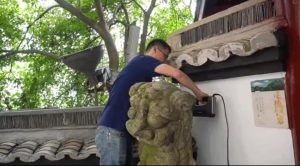
To bridge tradition with technology, SHINING 3D partnered with the site to digitally preserve and reproduce a stone lion sculpture located at the temple’s entrance—transforming it into a high-fidelity 3D printed cultural souvenir.
Challenge: Digitizing a Complex and Inaccessible Artifact
Preserving the sculpture required capturing its fine surface details and dimensions with high precision—despite limited access and spatial constraints.
Key technical challenges included:
- Restricted Scanning Environment: The lion was embedded close to a rock face with minimal working room.
- Surface Complexity: The sculpture’s aged texture and intricate contours required high-resolution capture.
- Artifact Sensitivity: Traditional molding or contact-based methods were not an option due to preservation concerns.
Solution: EinScan Pro HD for On-Site 3D Scanning
To overcome these limitations, the project team utilized the SHINING 3D EinScan Pro HD, a portable, multifunctional handheld 3D scanner.
Benefits of EinScan Pro HD:
Portability & Flexibility
Enabled precise scanning from tight angles and confined spaces with minimal setup.High-Speed Scanning
In handheld rapid scan mode, the scanner captured up to 1.5 million points per second, completing the full scan of the life-sized lion statue in just 5 minutes.Exceptional Detail Capture
In HD mode, the scanner achieved accuracy of up to 0.045 mm, preserving fine textures and intricate surface details necessary for faithful reproduction.
Digital Processing: Reverse Engineering in Geomagic Essentials
Once the scan data was acquired, the team transitioned into the reverse engineering phase using Geomagic Essentials. This involved:
- Surface Refinement: Smoothing rough patches and refining features while preserving key historical elements.
- Print Optimization: Enhancing the model for printability by adjusting overhangs, supports, and internal structures.
The resulting digital replica was print-ready and suitable for both display and mass production.
Production: High-Fidelity Printing with AccuFab-L4K
For the final step, the 3D model was printed using the AccuFab-L4K, SHINING 3D’s high-precision resin 3D printer.
Printer Highlights:
- 4K Resolution Output: Captures micro-textures and fine features with photographic clarity.
- Resin Stability: Ensures dimensional accuracy for batch production.
- Rapid Throughput: Ideal for small-scale souvenir manufacturing, providing consistent output over multiple runs.
The printed lion replicas served as authentic, tangible souvenirs—bringing historical art into the hands of modern visitors.
Conclusion: A Scalable Model for Cultural Heritage Preservation
This project at the Hanging Temple exemplifies how 3D scanning, reverse engineering, and additive manufacturing can be combined to preserve cultural artifacts, engage the public, and create new economic opportunities.
- Preservation: Captures a digital archive of endangered heritage
- Education: Offers scalable replicas for museums, schools, and exhibitions
- Commerce: Enables ethical reproduction of artifacts for tourism and retail


