
- Home
- About Us
- Solutions
Coordinate Measuring Machines (CMMs)
Portable Measuring Arms
- Resources
- Industries
- Contact Us

Football is one of the most popular sports in Egypt, enjoyed by millions of fans every day. While most people watch football for entertainment, engineers see something different: a fascinating demonstration of physics, mathematics, and engineering principles in action.
Every pass, shot, and save involves forces, motion, materials, aerodynamics, and energy transfer. These same principles are studied in engineering classrooms and applied in real-world product development.
Today, modern simulation tools allow engineers to analyze these phenomena virtually before building physical prototypes. One of the most widely used solutions for this purpose is SOLIDWORKS Simulation.
By exploring the science behind football, students, engineers, and manufacturers can better understand how simulation helps solve real engineering challenges.
Football offers an excellent example of how engineering concepts influence everyday life.
When a player kicks a ball, several scientific principles immediately come into play:
Engineers use simulation software to study these interactions and predict how products will behave under various operating conditions.
The same methods used to analyze football performance are applied to the design of machines, industrial equipment, vehicles, consumer products, and advanced manufacturing systems.
One of the most important engineering disciplines is structural analysis.When a football is struck, the ball experiences deformation caused by the impact force. Although this deformation occurs within fractions of a second, engineers can study and analyze it using simulation tools.
SOLIDWORKS Simulation enables engineers to:
Instead of building multiple physical prototypes, engineers can validate their ideas digitally and optimize designs before manufacturing begins.
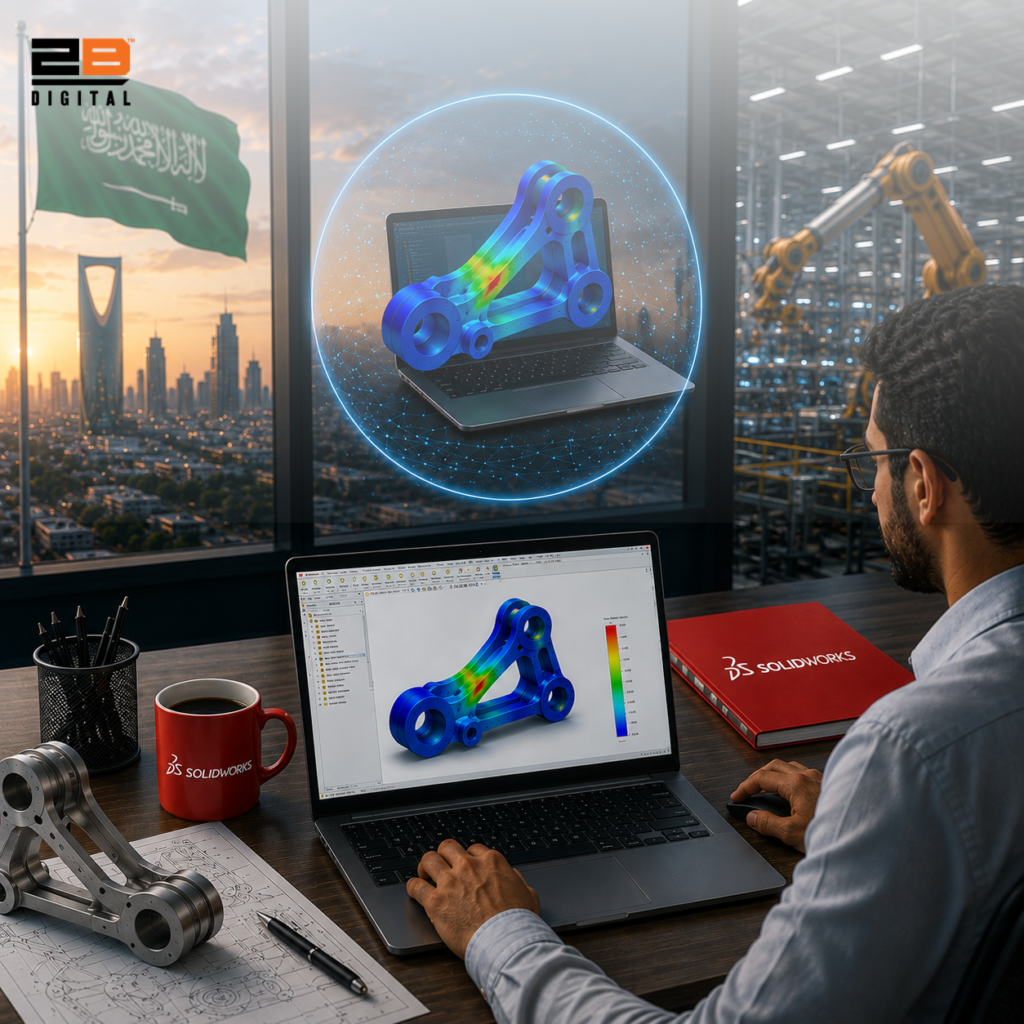
Structural simulation is widely used in:
As Egyptian manufacturers continue adopting modern engineering practices, simulation helps improve quality while reducing development costs.
Benefits of Structural Simulation
One of football’s most exciting moments is watching a player curve the ball around defenders and into the goal.
This movement is caused by aerodynamic forces acting on the spinning ball.
As the football travels through the air, differences in pressure create forces that influence its trajectory. Engineers use Computational Fluid Dynamics (CFD) to analyze these effects.
SOLIDWORKS Flow Simulation helps engineers study:
Through virtual testing, engineers can gain valuable insights into product performance without costly experiments.
Applications Beyond Sports
CFD simulation is commonly used in:
These applications help organizations improve efficiency, reduce costs, and optimize performance.
Benefits of Flow Simulation
Football is becoming increasingly dependent on technology.
Modern sports utilize:
These technologies rely on electromagnetic systems that must function accurately and reliably.
SOLIDWORKS Simulation tools help engineers analyze:
Simulation allows engineers to evaluate performance before building physical systems.
Electromagnetic simulation is used in:
As Egypt continues expanding its digital economy, these technologies are becoming increasingly important across multiple sectors.

Simulation is one of the most valuable skills engineers can develop today.
Modern organizations increasingly rely on virtual testing because it enables faster development, lower costs, and better products.
Engineers with simulation expertise can:
Simulation is no longer limited to large corporations. It has become an essential tool across industries of all sizes.


For engineering students, simulation provides the opportunity to:
Employers increasingly seek engineers who understand digital design and simulation technologies.
Building Future Engineering Talent in Egypt
As manufacturing and technology sectors continue growing, simulation skills help prepare future engineers for modern industry challenges.
Learning simulation allows students and professionals to bridge the gap between academic knowledge and real-world engineering applications.
Manufacturers face increasing pressure to deliver higher-quality products while reducing costs and accelerating time-to-market.
SOLIDWORKS Simulation helps organizations achieve these objectives by enabling engineers to test ideas virtually before committing to production.
Key advantages include:
Whether designing industrial equipment, optimizing manufacturing systems, or developing innovative technologies, simulation provides valuable insights throughout the product development process.

What is SOLIDWORKS Simulation?
SOLIDWORKS Simulation is an engineering analysis solution that enables engineers to test and validate designs virtually before manufacturing.
What is Structural Simulation?
Structural simulation analyzes how products respond to forces, stress, deformation, and real-world operating conditions.
What is CFD Simulation?
CFD (Computational Fluid Dynamics) studies airflow, fluid movement, heat transfer, and pressure distribution.
Why Should Engineering Students Learn Simulation?
Simulation helps students understand engineering principles, gain practical skills, and prepare for careers in modern engineering industries.
How Does Simulation Reduce Development Costs?
Simulation identifies potential problems before physical prototypes are built, reducing testing expenses and accelerating product development.
As an authorized SOLIDWORKS partner, 2B Digital Egypt helps students, educators, manufacturers, and engineering professionals adopt advanced simulation technologies.
Whether you are interested in engineering training, SOLIDWORKS certification, product design validation, or manufacturing optimization, our experts can help you build the skills and capabilities needed for success.
Contact 2B Digital Egypt today to discover how SOLIDWORKS Simulation can support your engineering and innovation goals.

